
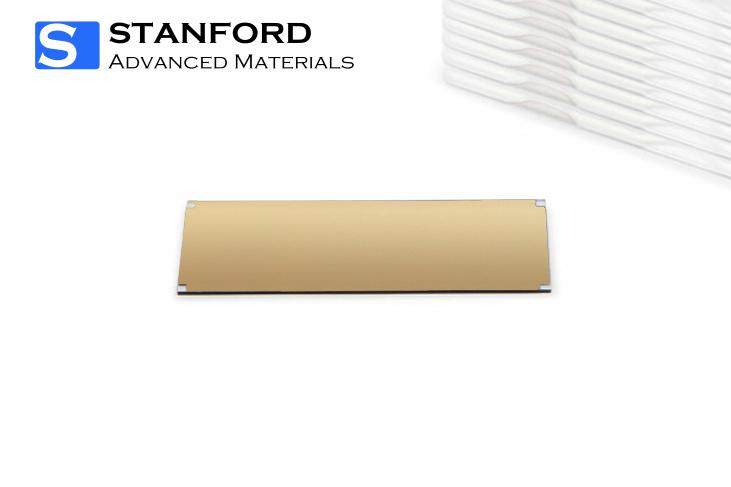
Titanium Nitride (TiN) Coated Glass Description
Titanium Nitride (TiN) Coated Glass consists of a dense, metallic TiN layer deposited onto a glass substrate to enhance chemical resistance, surface stability, and process reliability. The controlled PVD process ensures minimal surface variation and consistent coating thickness, which are essential for semiconductor environments where contamination control and interface uniformity are critical.
Titanium Nitride (TiN) Coated Glass Characteristics
| Parameter | Value |
|---|---|
| Material | TiN, Borosilicate Glass |
| Purity | TiN: ≥99.995% |
| Form | Substrate |
| Dimensions | 25 × 75 × 1 mm |
| Adhesion Layer | None (available upon request) |
| TiN Thickness | 500 Å |
| Coating Area | Single size (or customized) |
The above product information is based on theoretical data and is for reference only. Actual specifications may vary.
Titanium Nitride (TiN) Coated Glass Applications
Electronics and Optics
-
Used as a functional barrier layer to limit metal diffusion due to TiN’s chemical inertness.
-
Applied in optical assemblies where controlled reflectivity and smooth surface finish help reduce light scatter.
Semiconductor Manufacturing
-
Utilized in photolithography and deposition systems to improve process consistency by minimizing substrate-related variability.
-
Employed where a clean, stable glass interface is required for thin film development and device fabrication.
Titanium Nitride (TiN) Coated Glass Packaging
Substrates are packaged in static-shielding bags with cushioned supports to prevent mechanical damage and particulate contamination. Moisture-barrier sealing and controlled storage conditions are used to preserve coating integrity during transport. Customized packaging and labeling options are available upon request.
Additional Information
TiN-coated glass substrates provide an effective solution for semiconductor processes that require durable, chemically inert surfaces. Advances in PVD coating technologies enable tighter control over film thickness and surface quality, directly supporting high-precision manufacturing. The combination of borosilicate glass and TiN thin films reflects the growing role of engineered substrates in modern electronic materials processing.