Types of NCM Materials
Lithium‑ion batteries are the dominant energy storage solution in consumer electronics, electric vehicles (EVs), energy storage systems (ESS), and portable power tools. Among the cathode chemistries used today, Lithium Nickel Cobalt Manganese Oxide (LiNiₓCoᵧMn₁₋ₓ₋ᵧO₂) — commonly referred to as NCM or NMC — has emerged as one of the most versatile and widely adopted formulations due to its balanced performance and adaptability.
We'll explore the most common types of NCM materials used today — including NCM111, NCM523, NCM622, NCM811, and other variants — and explain how their compositions affect performance in real applications. We'll also provide a practical summary table for quick comparison.
 [1]
[1]
What Determines an NCM Type? Nickel, Cobalt, and Manganese Ratios
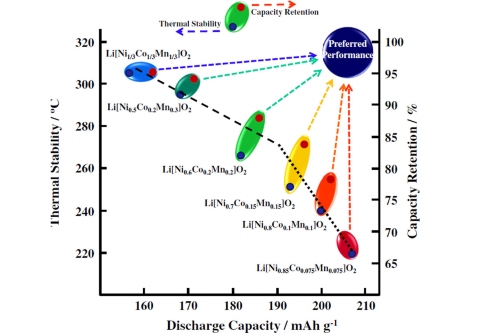
The key to understanding NCM chemistry lies in the three numbers that follow the abbreviation — for example, in NCM811, the numbers represent the ratio of nickel, cobalt, and manganese as 8:1:1. These ratios are nominal fractional values indicating how much of each metal is in the formula relative to the others.
Each metal serves a purpose:
- Nickel (Ni): Increases specific capacity and energy density — more nickel generally means higher stored energy.
- Cobalt (Co): Improves structural stability and safety, but is expensive and supply‑constrained.
- Manganese (Mn): Enhances thermal stability and cycle life, and helps balance nickel's reactivity.
By adjusting these ratios, manufacturers can tailor NCM cathodes to specific performance, cost, or safety targets.
Common NCM Types and Their Characteristics
1. NCM111 (NMC333)
Also known as NMC333, NCM111 has equal parts nickel, cobalt, and manganese (1:1:1). This balanced formulation was one of the earliest NCM cathodes studied and used.
Key Attributes:
- Balanced performance: Moderate energy density and thermal stability.
- Safety: Relatively stable due to balanced metal content.
- Cost: Higher cobalt content increases material cost.
Typical Use Cases:
Suitable for consumer electronics and applications where safety and stability are more critical than maximum energy density.
2. NCM523
In NCM523, the ratio shifts to 5 parts Ni, 2 parts Co, and 3 parts Mn (5:2:3). This increases the nickel content relative to cobalt and manganese.
Key Attributes:
- Improved energy density compared to NCM111.
- Good cycle stability and thermal behavior.
- Moderate cobalt content retains structural safety.
Typical Applications:
Mainstream EV batteries and mid‑range energy storage where a balance of performance and safety is desired.
3. NCM622
NCM622 increases nickel further to 6 parts Ni, 2 parts Co, 2 parts Mn (6:2:2), shifting performance toward higher capacity.
Key Attributes:
- Higher specific capacity and energy density than lower nickel variants.
- Reduced cobalt (lower cost, less dependency).
- Requires more advanced battery management systems (BMS) to control thermal and cycle stability.
Typical Applications:
Mid‑ to high‑end electric vehicles and portable power tools where added energy density improves runtime or driving range.
4. NCM811 (High‑Nickel NCM)
Highly popular in EV applications today is NCM811, with a ratio of 8 parts Ni, 1 part Co, 1 part Mn (8:1:1). The high nickel fraction gives NCM811 some of the highest energy densities among conventional NCM materials.
Key Attributes:
- Highest energy density of common NCM variants.
- Lower cobalt content significantly reduces cost and supply risk.
- Best suited for systems targeting lightweight and long‑range performance.
Trade‑offs:
High nickel content can compromise cycle life and stability, increasing reliance on optimized BMS and thermal management strategies.
Typical Applications:
Electric vehicles with longer driving ranges, advanced portable energy storage, and premium consumer electronics.
5. Other Variants: NCM442 & NCM333
Beyond the mainstream four, the market also sees variants like:
- NCM442 (4:4:2): Designed to balance cobalt and manganese content while keeping energy density reasonable, often used in mobile devices and mid‑tier EVs.
- NCM333: Another term for NCM111 (equal parts), used interchangeably in some literature.
Performance Summary and Comparison Table
The table below summarizes key characteristics and general trends among the main NCM types:
|
NCM Type |
Ni:Co:Mn |
Energy Density |
Cobalt Content |
Stability / Safety |
Typical Use Cases |
|
NCM111 |
1:1:1 |
Moderate |
High |
High |
Consumer electronics, general use |
|
NCM523 |
5:2:3 |
Moderately High |
Moderate |
Good |
Mid‑range EV & ESS |
|
NCM622 |
6:2:2 |
Higher |
Lower |
Moderate |
Higher‑performance EVs, tools |
|
NCM811 |
8:1:1 |
Highest |
Low |
Moderate‑lower* |
Long‑range EVs, premium energy storage |
|
NCM442 |
4:4:2 |
Moderate‑High |
Moderate‑High |
Balanced |
Mid‑tier devices and batteries |
Choosing the Right NCM Material
When selecting an NCM cathode, engineers must balance performance, cost, safety, and lifecycle requirements:
- Energy‑focused designs (like long‑range EVs) favor higher nickel content (NCM811) for superior energy density.
- Safety and cycle life priorities (aviation, ESS) may choose balanced compositions (e.g., NCM523 or NCM442).
- Cost constraints (budget EVs or consumer products) might optimize for reduced cobalt while maintaining safe operation.
Conclusion
NCM cathode materials occupy a central position in the evolution of lithium‑ion battery technology. By adjusting the nickel, cobalt, and manganese ratios, manufacturers finely tune a material's capacity, cost profile, and stability — enabling tailored solutions from high‑energy EV packs to safe energy storage systems. With ongoing research into high‑voltage and doped variants, NCM chemistry continues to evolve, pushing the boundaries of performance while balancing sustainability and safety. For more information, please check Stanford Electronics.
Reference:
[1] Heck, Carina & Horstig, Max-Wolfram & Huttner, Fabienne & Burmeister, Julian & Haselrieder, Wolfgang & Kwade, Arno. (2020). Review—Knowledge-Based Process Design for High Quality Production of NCM811 Cathodes. Journal of The Electrochemical Society. 167. 10.1149/1945-7111/abcd11.