Doping: How Semiconductors Learn to Conduct
Ever wonder how a tiny chip can control electricity so precisely? It all starts with a process called doping.
Doping in Semiconductors
So, What Exactly Is Doping?
Here's the simple version. You start with a pure semiconductor, and silicon is the classic example. Then, you deliberately introduce a tiny amount of impurity atoms. This significantly tweaks the material's electrical properties.
A silicon atom has four outer electrons. In its pure form, every silicon atom hooks up with four neighbors, forming nice stable bonds. The problem? There are basically no free electrons to carry current. So pure silicon? Terrible at conducting.
Now here's where it gets interesting.
If you add a little phosphorus, which has five outer electrons, something cool happens. The phosphorus bonds with four neighboring silicon atoms using four of its electrons, but that fifth one has nowhere to go. It's just... free. It can wander around the crystal carrying the current. This is what we call n-type doping, and those free electrons are our first type of charge carrier.
Go the other way, and things get even weirder. Add some boron - only three outer electrons - and now you've got a problem. When boron tries to bond with four silicon neighbors, there's a missing electron. It leaves a "hole." Other electrons start jumping into that hole, which creates the illusion of the hole moving around. Believe it or not, that moving hole acts just like a positive charge carrier. That's p-type doping.
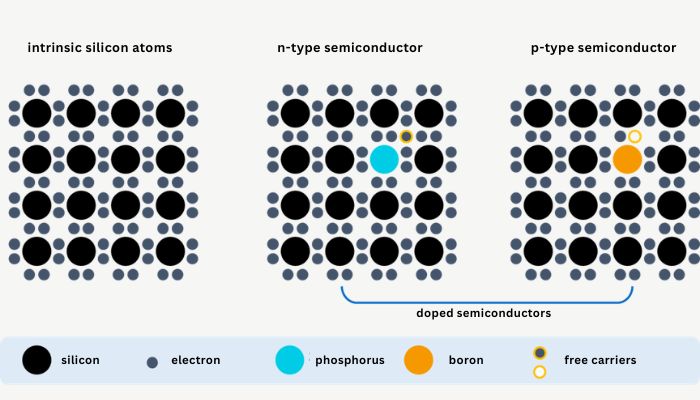
By carefully controlling this whole process, engineers can dial in exactly how many carriers they want and whether they're negative or positive. That's how we build all those fancy semiconductor devices.
Dopants in Semiconductors
Of course, you need the right dopants. For n-type doping, we grab elements with five outer electrons - phosphorus and arsenic are popular choices. For p-type, it's three-electron elements like boron and aluminum.
One workhorse in the industry? Boric acid powder. Sounds simple, but it's actually a brilliant source of boron. It's super pure, stable, and easy to handle.
Here's how it works: you coat a silicon wafer with this powder, crank up the heat, and those boron atoms diffuse right into the silicon crystal. Before you know it, you've got yourself a perfectly doped p-type region. And because boric acid doesn't have a bunch of nasty impurities and doesn't evaporate too easily, you get really consistent results.
FAQs about Semiconductor Doping
Q: What is the difference between n-type and p-type doping?
It really comes down to the impurity you add and how it affects the charge carriers.
With the n-type doping, you add phosphorus or arsenic. Both elements have five electrons in their outer shells, which means one electron is left over after they bond with another atom. This electron is the charge carrier.
With the p-type, you go with something like boron or aluminum, which only have three electrons. That creates a shortage of electrons, which is basically a "hole", and those holes end up acting as the charge carriers instead.
Q: Does higher doping concentration always lead to better conductivity?
For the most part, yeah—more dopants mean more carriers, so conductivity goes up. But in real-world chip making, you can't just keep cranking up the concentration, which may run into leakage current or lower breakdown voltage.
Q: What is the fundamental role of doping in chip manufacturing?
At its core, doping is all about controlling how well a semiconductor conducts electricity. But the big reason we do it? To create P-N junctions. Think of the P-N junction as the basic building block for pretty much every semiconductor device out there—diodes, transistors, you name it. By carefully controlling where and how much you dope on a silicon wafer, you can build all kinds of functional structures and wire them together into a complete integrated circuit.
Q: What happens if a doping error occurs, such as using the wrong type or an incorrect concentration?
If you use the wrong dopant type, you'll flip the polarity of your P-N junctions, and the device just won't work—period. Get the concentration wrong, and you'll mess with things like switching speed, how much voltage it can handle, and even power consumption. In chip manufacturing, doping is done with incredibly precise equipment for a reason. If something goes seriously wrong at this stage, that whole chip on the wafer is basically toast—and there's no fixing it.
Q: How is doping precision ensured in actual production?
The most common method used today is ion implantation. Here, the atoms are ionized and then implanted in the silicon crystal. This process gives us precise control over the amount and position of the dopants. After this process, the material is subjected to a high-temperature annealing process to heal the crystal lattice that has been damaged during the ion implantation process. This process is done in a clean room to ensure precise doping.