Thin Film Deposition: What Are PVD and CVD?
In today's high-tech manufacturing world, the performance breakthroughs of many critical components actually come from a thin layer you can barely see.
So how are these thin films made? The answer comes down to two main techniques: Physical Vapor Deposition (PVD) and Chemical Vapor Deposition (CVD).
PVD: The Physical Approach
Physical Vapor Deposition, or PVD, is pretty straightforward. Let's think of a block of titanium in a vacuum chamber. We are going to hit it with a beam of ions so hard that it will kick titanium atoms off the surface. They will fly all over the place, and some of them will land on our nearby equipment. When they hit, they will cool instantly and lock into place, kind of like a microscopic high-tech sandblasting, but instead of sandblasting, we are building up a surface.
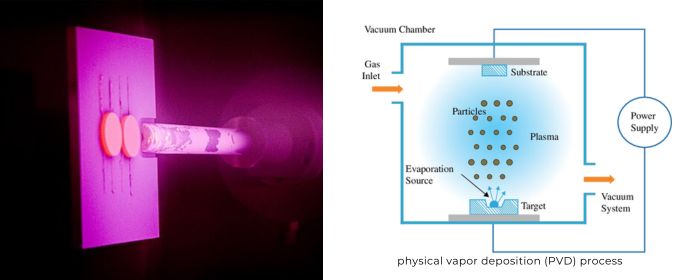
physical vapor deposition (PVD) process
There are a few common ways to do this:
- Evaporation: We heat the material until it evaporates, often using an electron beam. This method is great for making high-purity metal films and works well for creating fine patterns in microfabrication.
- Sputtering: This one's different. We create a plasma (an ionized gas) and shoot those ions at the target material. The ions knock atoms off the target, almost like playing a game of atomic billiards. Sputtering is fast, makes dense films, and can handle materials with really high melting points. It's probably the most widely used PVD method in industry today.
- Ion Plating: This is like evaporation or sputtering with an extra boost. We use a plasma to energize the depositing atoms. When these high-energy ions hit the surface, they make the film much denser and stick way better. It's especially popular for coating cutting tools.
CVD: The Chemical Approach
Now, CVD, or Chemical Vapor Deposition, is a whole different story. Instead of moving atoms, it's about making a new material through a chemical reaction.
CVD works completely differently from PVD. We're not kicking atoms off a target. Instead, we flow reactive gases into a chamber, and when they hit the hot part surface, they chemically react and deposit a solid film. The excess gas just gets pumped out.
So if PVD is about moving atoms, CVD is about growing a film through chemistry.
CVD is the go-to method for making high-purity silicon for electronics, and even wild stuff like synthetic diamond, graphene, and carbon nanotubes.
CVD's big advantage is that it's not line-of-sight. Because it's gas-based, it flows into every little feature—deep holes, complex 3D structures, you name it. That's called step coverage, and it's why CVD is essential for making MEMS and advanced chips. PVD just can't reach those hidden areas.
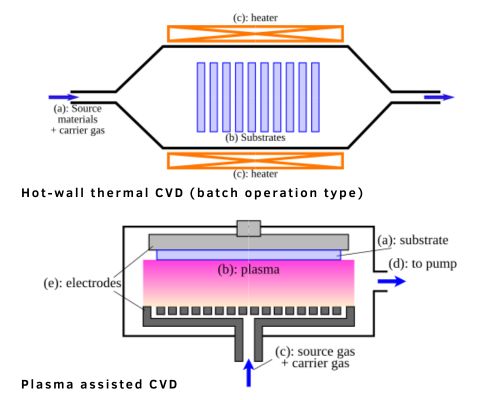
To make it more practical and energy-efficient, CVD has evolved too:
- Thermal CVD: This is the classic way. We use high heat (usually 600°C to over 1000°C) to drive the chemical reaction. The films are top quality, but the part has to withstand those extreme temperatures.
- Plasma-Enhanced CVD (PECVD): This is a game-changer. We use plasma to provide the energy for the reaction, which means we can do it at much lower temperatures (sometimes as low as 100°C to 300°C). This lets us deposit films on things that can't take the heat, like regular glass or even flexible plastics. It's huge for displays and flexible electronics.
- Low-Pressure CVD (LPCVD): By running the process at low pressure, the gases move and diffuse faster. This allows us to coat lots of parts at once, really evenly. It's a workhorse in semiconductor fabs.
PVD vs. CVD: Key Differences and When to Use What
So, which one wins? It depends entirely on what you're trying to do. Here's a quick comparison:
First, Temperature. PVD is generally a lower-temperature process, typically between 200°C and 500°C. This means less risk of damaging the part you're coating. You can even coat hardened steel tools without softening them. CVD, especially the traditional kind, often runs much hotter (over 800°C). The films stick great, but you're limited to materials that can handle the heat.
Second, Coverage. This is a big one. PVD is a "line-of-sight" process. If the plasma or vapor can't "see" a surface, it won't coat it well. Think of it like spray paint – you can't easily paint the inside of a deep hole. CVD, on the other hand, uses gases that flow and diffuse everywhere. It can uniformly coat complex internal passages and blind holes with no problem.
And then there's PECVD, which is kind of a hybrid. It uses the plasma (a PVD trick) to drive a chemical reaction (the CVD part). It gives you the best of both worlds – good quality films at lower temperatures.
Where You See Them in Action
PVD and CVD each have their own specialties in the real world.
You see PVD all the time. That gold-colored coating on drill bits? That's Titanium Nitride (TiN) put on with PVD. The shiny, scratch-resistant finish on your watch or your phone's metal frame? Probably PVD, too. In chip manufacturing, PVD sputtering is a key step for putting down the metal wiring.
CVD is the king of tough coatings and advanced electronics. Those super-hard coatings on carbide cutting tools for heavy-duty machining? Often applied with CVD. More importantly, CVD is absolutely fundamental to making semiconductors. Growing silicon layers, depositing insulating materials, and making new materials like graphene all rely on CVD.
What's Next: Getting Even More Precise
Of course, our ongoing quest for smaller, faster electronics and stronger tools continues to drive innovation in deposition technology.
Atomic Layer Deposition (ALD), for example, is just a fancy name for CVD on steroids. It's the ability to deposit material one atomic layer at a time. This is giving us unprecedented control over thickness, even on the most complicated 3D geometries for the most advanced computer chips.
We're also seeing more and more hybrid approaches, such as the use of plasma to allow for more control over the film's structure at lower temperatures. And, naturally, even these technologies are being aided by the advent of machine learning and automation to make these processes even more precise and more efficient.
And so, there you have it: PVD and CVD, the two basic ways we build things up, atom by atom, to make our high-tech world possible. From the chip in your phone to the blade that cuts the metal for your car, these two technologies are what make it all possible.
Stanford Electronics offers a full range of sputtering targets and evaporation materials. Check out our product guide for more information.