
Titanium Nitride (TiN) Thin Films in Chip Manufacturing
In the chip-making process, when metals like copper are used as interconnect materials, one problem you absolutely have to solve is preventing metal atoms from diffusing into the silicon substrate. Once copper gets into silicon, it changes the silicon's electrical properties. That leads to higher leakage current in the device, and can even cause PN junctions to fail. Titanium nitride (TiN) thin films are the key material that solves this problem.
1. Properties of Titanium Nitride (TiN)
Titanium nitride is a gold ceramic material that combines the properties of both metals and ceramics.
Titanium nitride has a hardness close to that of natural diamond, so it offers excellent wear resistance. At the same time, it's a good conductor, not an insulator, which means it can conduct electricity in a circuit. Also, TiN has a melting point of 2930°C, so it stays stable during high-temperature processes.
Titanium nitride also has a high refractive index in the visible light range. Its thermal conductivity isn't as high as pure metals, but it's still decent.
On the chemical side, TiN is stable against most chemicals at room temperature and has good corrosion resistance. It doesn't oxidize at room temperature. You have to heat it above 800°C in an oxygen atmosphere before it turns into white TiO₂.
2. What Titanium Nitride Thin Films Do in Semiconductors
2.1 TiN Works as a Diffusion Barrier
Why do you need a diffusion barrier? Copper atoms really want to diffuse into silicon. When copper gets into silicon, it creates deep energy levels that increase the device's leakage current. Also, copper diffusion can change the doping concentration in the silicon, which can mess up the carefully designed PN junctions so they don't work right.
What is the solution that TiN brings to solve this problem? TiN is characterized by its dense crystalline structure with minimal defects and pores inside. In such a way, it is difficult for metal atoms to permeate into the material. Thus, the TiN thin film works as a physical block between the copper interconnect and the silicon substrate. It stops the diffusion of copper into the silicon or other materials below the thin film.
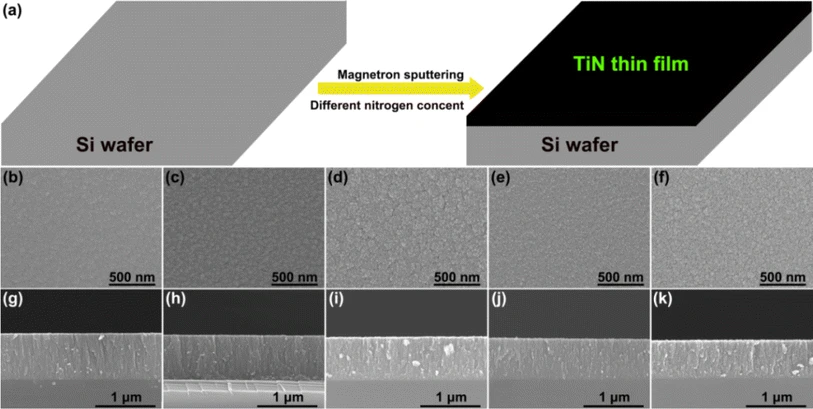
Fig 1. Schematic illustration of the fabrication process, b–f Surface morphologies and g–k Cross-sectional microstructures of TiN thin films[1]
2.2 TiN Works as a Contact Layer
As already mentioned above, titanium nitride also acts as a contact material. When TiN is exposed to silicon at high temperatures, the TiN near the interface will disintegrate and release titanium atoms. These titanium atoms combine with silicon atoms to create titanium silicide. Titanium silicide is a low-resistance material commonly used in the source/drain contact regions of the transistors.
2.3 Other Roles
Beyond being a diffusion barrier and contact layer, TiN thin films also do a few other jobs in semiconductor manufacturing:
- Hard mask: Acts as a spacer layer in multi-patterning processes, with better etch selectivity than traditional SiO₂.
- Anti-reflective coating: Reduces bottom reflection during photolithography, improving pattern accuracy.
- Electrode material: Used in newer devices like ferroelectric memories and memristors.
3. How Titanium Nitride Thin Films Are Made
TiN films can be deposited by using two methods: PVD (physical vapor deposition) and ALD (atomic layer deposition).
Physical vapor deposition (PVD) involves sputtering a material under vacuum conditions in combination with a nitrogen flow. The high-vacuum chamber contains a plasma that sputters titanium from the target material. The interaction between the sputtered titanium and the nitrogen forms TiN that coats the substrate surface. This method is well-developed and suitable for bulk manufacturing.
In Atomic layer deposition (ALD), the reaction takes place in pulses, where each cycle results in depositing one atomic layer. Using titanium precursor (TDMAT/TiCl₄) in alternation with nitrogen source (NH₃) leads to precise film growth. It is suitable for the manufacture of advanced structures due to the great step coverage.
4. Stanford Electronics Offers TiN-Coated Silicon Wafers
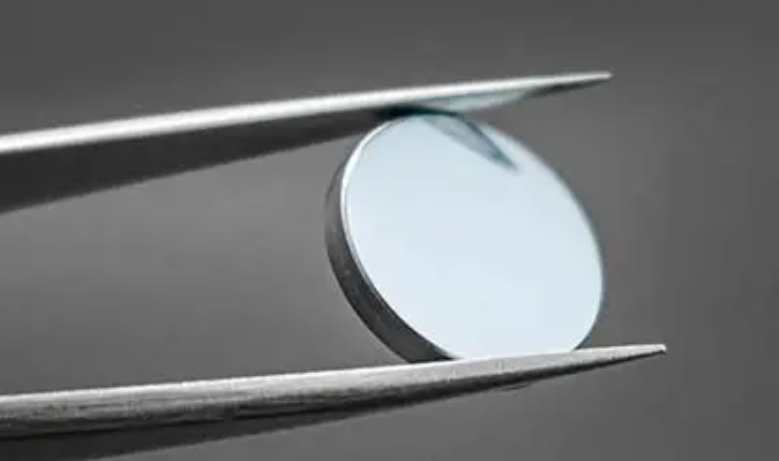
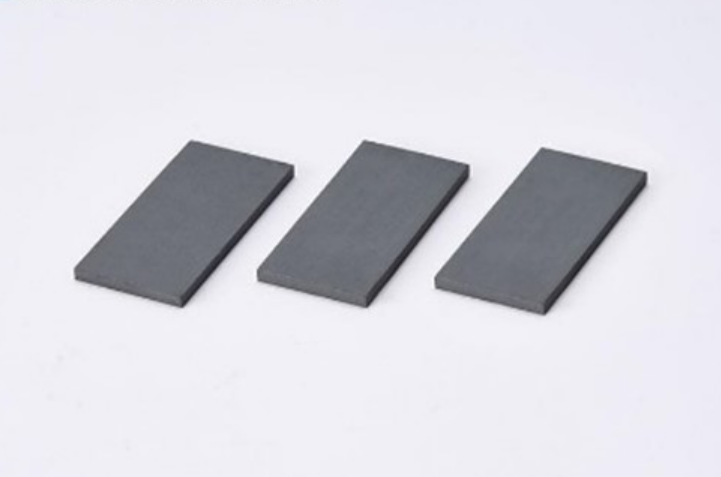
Titanium nitride (TiN) coatings form an integral part of semiconductor chip fabrication, serving as diffusion barriers and contact layers because of its high hardness, electrical conductivity, melting point, and stability. Stanford Electronics manufactures silicon wafer products with titanium nitride coating using sputter deposition processes, in-situ controlled for better control of the deposited layer thickness and uniformity.
Titanium Nitride (TiN) Coated Silicon Wafer
.jpg "Silicon Dioxide (SiO2 quartz)")